Written by Andy Rogerson, EW & Electromagnetic Spectrum Operations Training & Consultancy Expert
High-power microwaves (HPMs) are an emerging class of directed energy weapons (DEWs) that utilise intense bursts of microwave energy to disrupt or disable electronic systems.
As modern warfare increasingly relies on electronic and digital infrastructure, HPMs represent a powerful tool for countering a variety of threats, from drones and missiles to communication networks and radar systems.
Unlike conventional munitions, which destroy targets through kinetic force or explosives, HPMs incapacitate electronic components by inducing high voltages and currents, leading to malfunctions or permanent failure.
HPMs operate within the electromagnetic spectrum, typically emitting frequencies in the range of megahertz (MHz) to gigahertz (GHz). The use of electromagnetic waves allows for precise targeting of electronic systems without causing physical destruction to surrounding infrastructure.
HPMs can be designed for focused energy projection, allowing more controlled and repeatable effects.
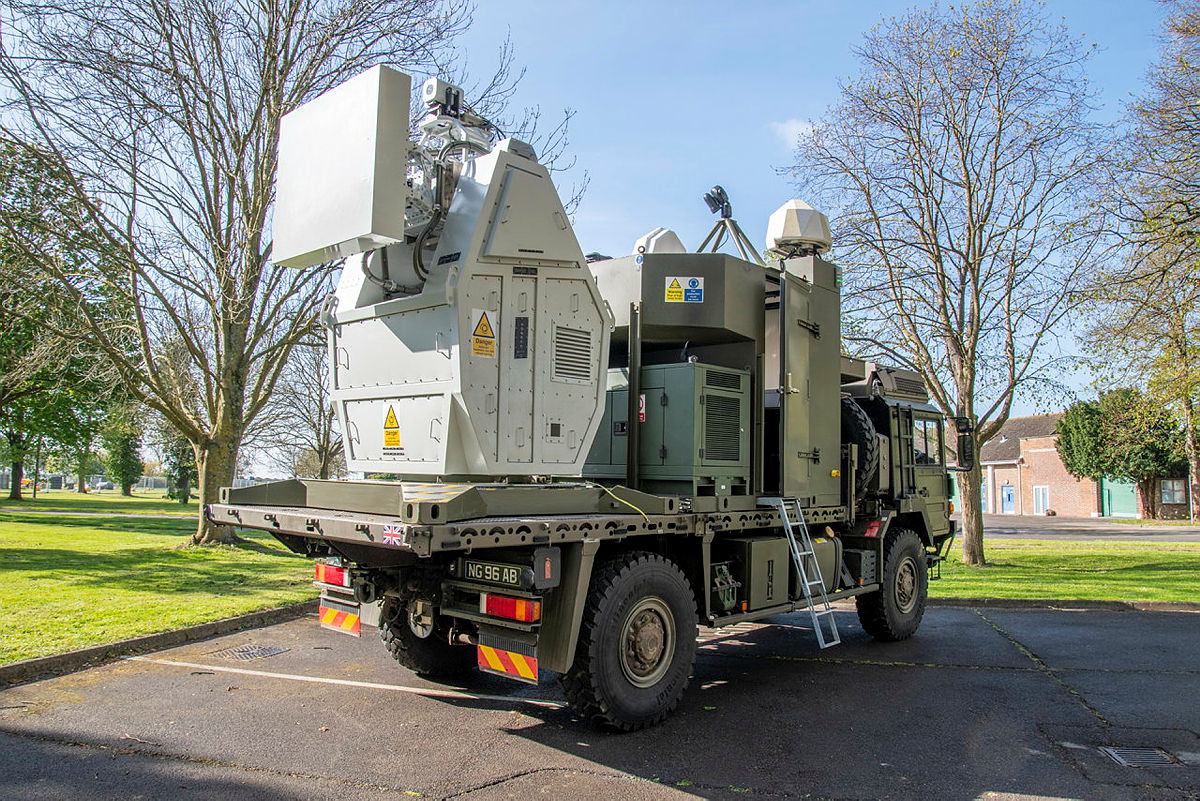 Image of the Radio Frequency Directed Energy Weapon developed by the Defence Science and Technology Laboratory (Dstl) and Thales. Seen here at 7th Air Defence Group at Thorney Island in the UK. UK MOD © Crown copyright 2024.
The effect of a HPM is the scale of power applied. Whilst a conventional radar might result in microwatts to milliwatts of power received at a target, a HPM might achieve kilowatts to megawatts of power on target. There are few natural causes that might result in a platform receiving this level of power, placing HPMs in a category of power delivery similar to lightning.
It is easy to imagine how these high-power levels can induce failures in electronics and interference of data transfer between components. Suffice to say, one doesn’t use an HPM to heat lunch-time soup.
HPM technology provides several advantages over traditional kinetic and electromagnetic warfare capabilities:
Non-lethal effects: HPMs can disable enemy systems without causing direct physical harm to personnel or infrastructure, making them suitable for scenarios where collateral damage must be minimised.
Speed-of-light engagement: as electromagnetic waves travel at the speed of light, HPM weapons can engage targets instantly, providing rapid response against fast-moving threats such as UAVs and cruise missiles.
Deep magazine: unlike conventional weapons that rely on finite ammunition, HPMs can be fired repeatedly as long as sufficient power is available.
Scalability and versatility: HPMs can be tuned to affect specific systems or create area-wide disruption, making them adaptable to various operational requirements.
 Image of the Radio Frequency Directed Energy Weapon developed by the Defence Science and Technology Laboratory (Dstl) and Thales. Seen here at 7th Air Defence Group at Thorney Island in the UK. UK MOD © Crown copyright 2024.
Several nations are actively researching and developing HPM-based weapon systems for battlefield applications:
Counter-uncrewed aerial systems (C-UAS): HPMs have been integrated into counter-drone platforms to neutralise swarms of UASs, disrupting their electronics and preventing coordinated attacks.
Missile defence: some HPM systems are being evaluated for their potential to disable incoming missiles before they reach their targets.
Naval and ground-based systems: military forces are exploring the use of HPMs on warships, ground vehicles, and fixed installations for air defence and electromagnetic attack missions.
High-power microwave weapons represent a transformative capability in modern warfare, offering non-lethal, scalable, and rapid-response options for countering electronic threats.
While challenges remain in power generation and operational deployment, ongoing advancements suggest that HPMs will play an increasingly significant role in defence strategies.
As the technology matures, integrating HPMs into a broader spectrum of electromagnetic and cyber warfare tactics will be essential in maintaining technological superiority on the battlefield.
Our Fundamentals of Air Electromagnetic Warfare (EW) Course is the perfect opportunity to develop your knowledge, and provides the information needed to understand tools such as HPMs.
This course is not only suited for military customers, but also:
Those with an active interest in the topic, such as individuals working in journalism and academia
Corporate sales, marketing or business development personnel responsible for EW or electromagnetic spectrum operations functions, but without a military background in the topic
Find out when our next course will take place here.