Prussian military strategist, Carl Von Clauswitz, drew attention to the similarities between military combat and business. Warfare has gone through dramatic transformations since those words were uttered, but so has business, and the similarities remain as strong as ever. This blog is about how Inzpire uses military principles in its business environment.
Around 75% of Inzpire’s staff are former military personnel, so it is not surprising that we have sought to adapt military skills and knowledge to a commercial context. Judging by the success we are having it seems to be working…
While business is not warfare there are a number of striking parallels between the two: direct competition, the use of tactics and counter-tactics, the employment of grand strategies, the use of technology, the ubiquity of rapid and disruptive change, fleeting opportunities, the zero-sum nature of many contests, the need to act with incomplete information, uncertainty about who the opponents actually are, a sense of disorder, the chaos of competition and the ultimate reliance on people to deliver the end results.
Military strategy, like business strategy, has had to evolve in response to all these conditions and there is much that each can learn from the other. At Inzpire our approach to business exploits what the military calls the manoeuvrist approach. This is a style of fighting that emphasises speed and agility, avoiding an opponent’s strengths, creating confusion and disorder and then striking hard at critical vulnerabilities.
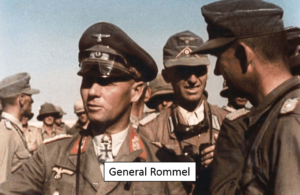
The 1937 publication of Infantry Attacks by the well-known German military officer Erwin Rommel was one of the first articulations of the manoeuvrist approach, which was validated shortly thereafter by the success of German blitzkrieg tactics during World War II.
Since World War 2, these same manoeuvrist ideas have resulted in decisive victories for the Israeli Defense Force in the Arab—Israeli Wars of 1967 and 1973 and for the Coalition Forces in Operation Desert Storm in 1991, among others. The manoeuvrist philosophy is tailor-made for small, light forces with relatively few resources.
Being a small light company in a defence world full of giant and powerful behemoths, we believe that the manoeuvrist concept is directly relevant to our business strategy, precisely because it has been developed to address conditions that mirror our current situation. As we see it, the ideas underpinning the military manoeuvrist approach can be morphed in to a parallel idea can be called “manoeuvrist business”.
Manoeuvrist business suits us because most of our opponents are much bigger and stronger than us. So we can only defeat them by actively avoiding their strengths, by quickly and aggressively identifying and exploiting their critical vulnerabilities, by confounding them with our speed and agility, by forcing them to react to us, rather than the other way around, by getting inside their decision cycles and by then attacking them in ways that hurts them the most.
Our aim is not to destroy them but to render them unable to effectively operate. We relish opportunities mired in uncertainty and disorder and we embrace that chaos, combined with our ability to make quick decisions, in ways that are aimed at confusing and unhinging our competitors by rendering them unable to comprehend a situation fast enough and react in time. This helps us achieve a decisive advantage with a minimal deployment of resources.
Some of the tools that we use in our manoeuvrist approach to business have been learned from the German Concept of Blitzkreig or lightning war. These are, in the original German terms: einheit; fingerspitzengefühl; auftragstaktik; and schwerpunkt.
Einheit
The literal meaning is "mutual trust". It’s the sense of cohesion that arises from knowing that one can depend utterly on fellow team members to do what’s expected. Mutual trust can’t be mandated or imposed. It develops over time and it’s earned. You see it a lot in military situations where each member of a formation or unit has to totally trust the others (with his or her life). Mutual trust comes naturally to a company which is so heavy on military experience.
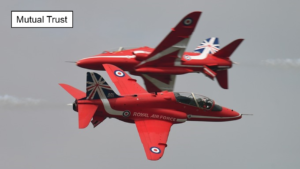
At Inzpire, mutual trust is the invisible fuel and super-lubricant on which our whole business runs. We believe in giving people autonomy, mastery and control in their work. We try to stamp out the permission seeking behaviour so prevalent in many organisations. We give people genuine authority to think and act for themselves. We allow our people to live where they like (a significant number of us live overseas), to work from home whenever they need to and we offer totally uncapped leave. We believe everyone should be within the circle of trust, until they prove themselves not worthy. This is the opposite of how most organisations operate, despite what they claim.
Fingersptizengefühl
Literally “fingertip feel” it implies intuitive skill. This is the consummate skill that comes from having done something so much that it is totally intuitive. It is about allowing space for intuition and instinct in decision making and avoiding the curse of ‘paralysis by analysis’. Data hunger is a cancer that is destroying many organisations. We do not need ever more data to make decisions. It is the job of their leaders to make decisions with incomplete data; that is what we are paid for. We do not need to know the dimensions of every step on the staircase; sometimes we just need to take the first step.
Here at Inzpire we are a company based on tacit knowledge. With over 2000 years military experience we have fingerspitzengefulhl in spades when it comes to our niche area of military aviation.
Auftragstaktik
This is a style of leadership sometimes called Mission Leadership. It is about giving people clearly defined goals but not prescribing how those goals should be achieved. Leaders who lead in this way give subordinates great freedom to exercise initiative, flexibility and creativity in execution. It is all about defining an objective but letting those closest to the action make the tactical decisions. This of course required considerable einheit and fingerspitzengefuhl, so these things all link together in a rather beautiful way.
At Inzpire, we are often surprised by the sheer level of micromanagement that we witness in larger defence businesses. Precious little einheit there it seems! If it takes a company several months to make a decision because that decision has to be approved by several levels of hierarchy then something is wrong.
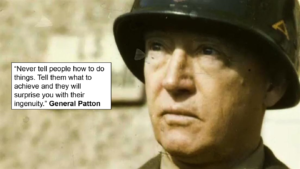
Here at Inzpire, we believe in the words of General Patton “Never tell people how to do things. Tell them what to achieve, and let them surprise you with their ingenuity”. That is the essence of mission leadership or auftragstaktik.
Schwerpunkt
This means the focus - the place where the majority of effort should be directed (normally at an opponent’s critical weakness). It is also is often called “The Main Effort” in today’s military circles. The Main Effort needs to be well understood as it is the ball that can’t be dropped at that moment. And no you can’t have lots of them!
Main Effort or Schwerpunkt links with all the previous concepts but also with the concept of a clearly communicated Leaders Intent, though which the head of an organisation clearly communicates what he or she is trying to achieve.
At Inzpire we are crystal clear about what we are trying to achieve.
Our 15 year vision is to become the most respected and trusted defence company on the planet.
This is not some dream, we intend to achieve it through igniting a revolution of honour integrity and trust in the defence industrial environment. This is basis of our very existence and the whole reason the business exists in the first place.
Yes, making money is essential to us (we have to pay our people) but it is not the primary goal. We see profits as a by-product of a life well lived.