
Jeff Sutherland was a US navy fighter pilot, he flew over 100 missions over Vietnam in an RF4-C. After 11 years’ service he went on to achieve a PhD in Biometrics, carried out cancer research for 8 years and then went into business. He started out by leading a team of software developers who were working on a project to deliver Automatic Teller Machines.
When he joined the team, the project was running ever late and over budget. He convinced his CEO to let him try something new. Jeff detested the standard ‘waterfall’ process which extoled the virtues of planning everything in minute detail months in advance and then produced things which took years to complete. Gantt charts (developed by Henry Gantt in 1917) are a product of this management method, but they are out of date as soon as someone turns up late for work on day-one of a project. Most managers like Gantt charts because they promote an atmosphere of top-down, leader-follower control; a leadership method we aspire to avoid in our company.
By concentrating on achievable goals, Jeff’s system evolved and matured. His boss asked Jeff what he was going to show him at the end of the month in place of a Gantt Chart. He replied ‘a product; a working piece of software which you will be able to try out and critique’.
Instead of planning in too much detail too far ahead, his system relied on planning packages of work lasting between 2-4 weeks. Each of these ‘sprints’ aimed to have something tangible to demonstrate at the end of it, in order to allow stakeholders to try things out, change their minds or tweak things before the team committed to the next sprint. Of course, as these sprints all aim to produce a facet of the final product – be it a software function, the roof of a house or an understanding a GCSE topic – there has to be some effort spent in forward planning to guide the overall development of the project.
Jeff witnessed a measurable increase in his team’s productivity of over 400% in 6 months, which saw the project being successfully delivered early and on budget. They were responsible for developing the software which ATMs relied on to precisely value every bank account in North America, software which is still in use today all over the world.
Jeff named his process ‘Scrum’ – it isn’t an acronym, it is named after the Rugby discipline where a team of 8 people all work together toward the same aim. He realised that his process had potential to work in any venture, not just software development, so he wrote a book about it.
I will leave the finer detail for future articles, or for you to research yourselves if you like the sound of it. What I thought was most applicable to all of us in Inzpire were two statements which the book challenged:
1. Working longer gets more done.
2. Humans are brilliant at multi-tasking.
Working longer gets more done.
This is the widely held, traditional view of working. And it makes sense: the more time you spend doing something, the more of it you will achieve right? Wrong.
The graph below is from a study Jeff Sutherland refers to in Scrum. It shows that not only is productivity affected by working long hours, but so too is quality. Every graph on this subject shows the same thing; they all agree that after about 47 hours work in any week, you are heading back down towards production levels similar to those you would have achieved at the 20 hour point!
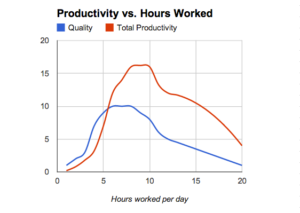
One of the key reasons for this drop in productivity is the quality of the work, which tends to fall off at 35 hours per week. Research has established that if you make a mistake, then fail to identify and rectify that mistake on the very same day, it can take much longer to fix it down the road, up to 24 times longer if you leave it just 3 weeks.
Lesson
Working more than 47 hours per week actually reduces output. All-nighters or working weekends and evenings (just like you see in films during the montage bit), might feel great as everyone pulls together towards a deadline, but they are actually damaging your output. Fix errors as soon as you can.
Humans are awesome at Multi-tasking.
‘Men aren’t’ I hear the ladies cry! You may be right, we’ll get to that very shortly.
Research conducted at Stanford University found that multitasking is less productive than doing a single thing at a time. They also found that people who regularly deal with several streams of electronic information (my teenage children for instance) cannot pay attention, recall information, or switch from one job to another as well as those who complete one task at a time.
But what about fighter pilots?
Researchers compared groups of people based on their tendency to multitask and their belief that they’re good at it. They found that those who multitask a lot and feel that it boosts their performance were actually worse at multitasking than those who like to do a single thing at a time. The frequent multitaskers performed worse because they had more trouble organising their thoughts and filtering out irrelevant information, and they were slower at switching from one task to another.
Multitasking Lowers IQ
Multitasking makes you stupid - fact. A study at the University of London found that their subjects, given a simple cognitive task to carry out while watching TV or answering the phone, suffered an IQ drop exactly as they would experience if they had smoked marijuana or stayed up all night. IQ drops of 15 points for multitasking men lowered their scores to the average range of an 8-year-old child. Women’s IQ only dropped 10 points (told you we’d get to that).
Lesson
On the phone while Driving? Emailing while in a meeting? Answering emails while writing an article for the CEOs newsletter? You might as well be stoned. Or 8 Years old.